
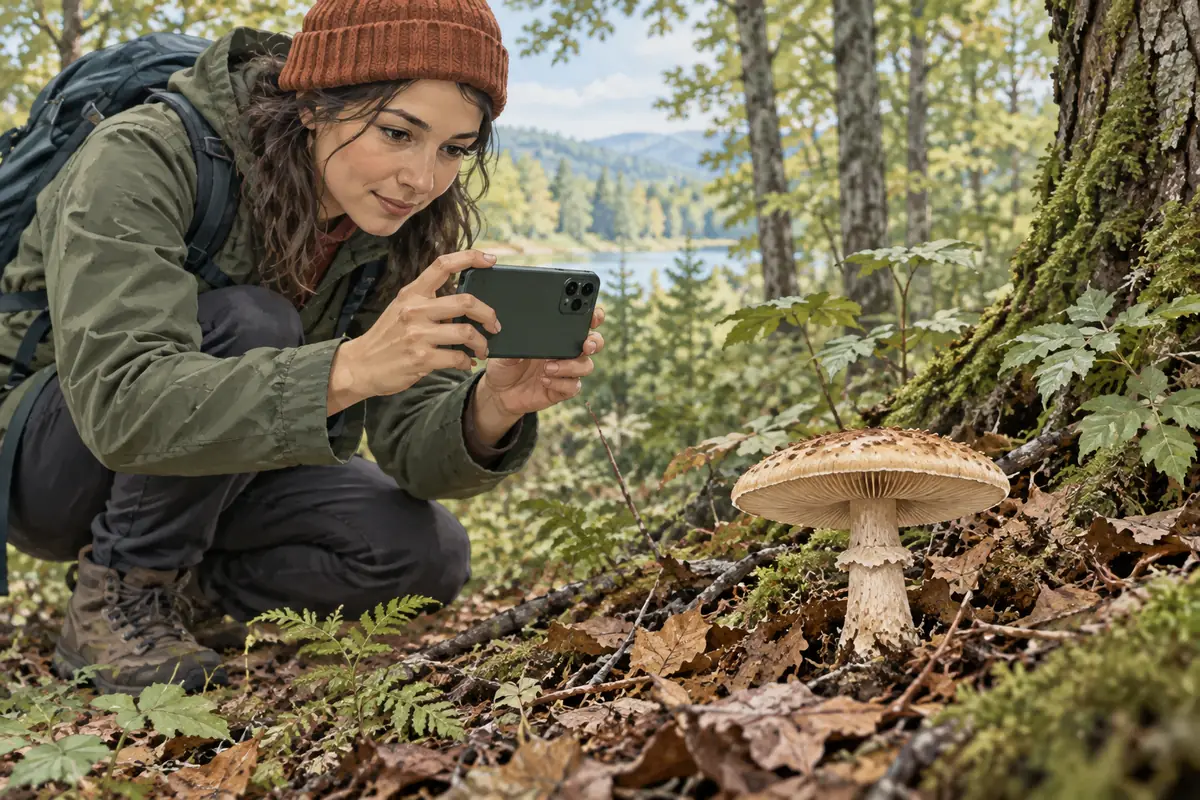
Short answer: To identify a mushroom by photo, photograph more than the top of the cap. Capture the cap profile, underside, stem, base, full growth pattern, and nearby habitat in even light. Compare several clues, keep lookalikes in view, and treat an online result as a research lead. If the answer affects eating, poisoning, pets, or medical safety, stop at visual comparison and ask a qualified local expert or poison-control resource.
Begin with usable evidence
Start with a clear photo, not a confident guess
The best way to identify a mushroom by photo is to make the image useful before you search for a name. A distant picture, a strong color filter, or a cropped cap may look attractive but leave out the structures that separate similar mushrooms. Begin with a sharp, evenly lit frame and keep the whole specimen in view when possible.
A photo is evidence for comparison, not a certificate. Light, moisture, age, camera processing, damage, and regional variation can change a mushroom's appearance. Even a good image may not show microscopic features, spore information, chemical reactions, maturity, or the full habitat. The goal is to narrow the next question while keeping uncertainty visible.
- Use natural or diffuse light and keep the main mushroom in focus.
- Show enough of the scene to understand scale, substrate, and whether the mushroom grows alone or in a cluster.
- Keep the original image; avoid filters that change color or erase surface texture.
Give the image more structure
Photograph the right angles: cap, underside, stem, and habitat
One image rarely shows every clue. A small sequence is more useful than a single dramatic close-up because it preserves relationships between the cap and stem, the underside and its attachment, and the mushroom and the surface where it grows. Move the camera instead of moving or cutting the specimen, and avoid touching an unknown mushroom just to improve the frame.
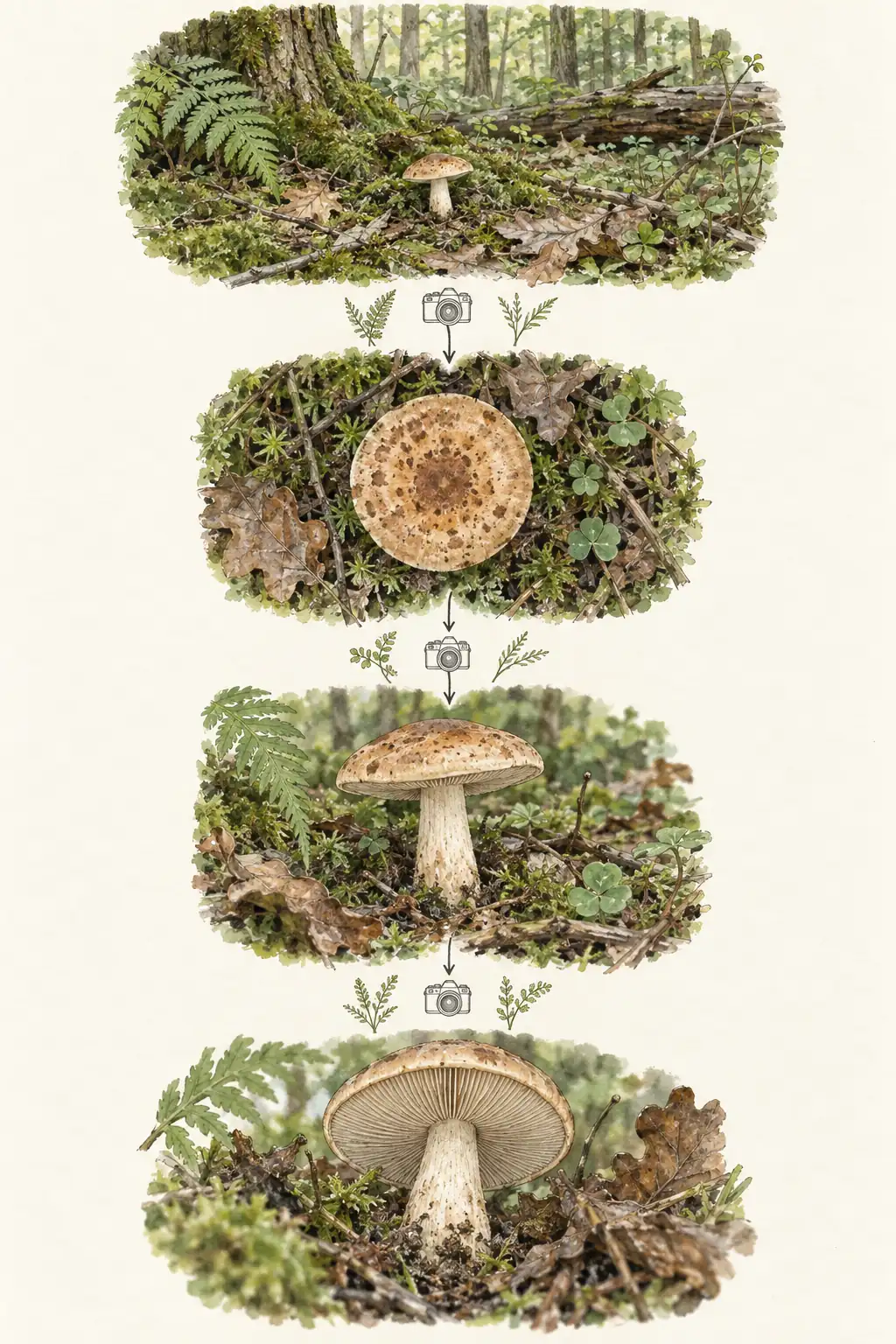
1. Cap and side profile
Take one view from above and one from the side. The overhead view records the outline, center, margin, surface zones, scales, cracks, or fibers. The side profile shows whether the cap is convex, flat, depressed, funnel-shaped, bell-shaped, or irregular, as well as its thickness and relationship to the stem.
- Keep the full cap edge in the frame.
- Avoid flash glare on wet or shiny surfaces.
2. Underside and attachment
The underside may show gills, pores, teeth, folds, or another fertile surface. Photograph it close enough to reveal the pattern while keeping the point where it meets the stem visible. Note whether the structure appears to run down the stem, stop before it, attach directly, or remain separated; if the attachment is unclear, say so rather than forcing a label.
- Show the entire underside and its connection to the stem.
- Use the broad terms gills, pores, teeth, or folds until a reliable source supports more detail.
3. Stem, base, and habitat
Photograph the stem from the side and include the base when it is visible without disturbing the mushroom. Useful observations include central or off-center attachment, smooth or textured surface, ring-like structures, swelling, tapering, and color changes. Do not dig up, taste, or closely smell an unknown specimen for the purpose of getting a better picture.
- Show the growth pattern instead of cropping to one cap.
- Keep a safe distance and leave the specimen undisturbed.
Describe before naming
Compare visible clues as a group
Before typing what mushroom is this, write a short description of what the camera actually shows. For example: a pale tan cap with a wavy margin, pale folds beneath, a central textured stem, and several specimens growing from moss beside a fallen branch. This style of note is more useful than starting with a familiar name and then ignoring features that do not fit.
When you compare mushroom identification pictures, compare the same feature in the same order. Check the cap, underside, stem, base, growth pattern, and habitat. A candidate that matches one color but conflicts with the underside or substrate should remain a lookalike, not become the final answer.
Let several clues agree
Strong comparisons use several independent observations. Cap color and shape can start the search, but underside structure, attachment, stem details, and habitat should support the same direction. If the clues disagree, record the disagreement and widen the candidate group.
Maturity also matters. A young mushroom may hide its underside or ring, while an older specimen may lose color, flatten, split, or become damaged. Use words such as appears, visible, or uncertain when the photograph cannot settle a feature.
- Rank structure and relationships above a single color impression.
- Compare candidates from the same region and habitat when possible.
Interpret the output carefully
Understand likely matches, lookalikes, and next steps
An online result is most helpful when it gives you a next observation instead of only a name. Read the likely match as a visual hypothesis, then check the broad group, visible clues, possible lookalikes, and suggested next step. Ask whether the returned explanation matches the actual photo or whether it is relying on a feature that is hidden, blurry, or absent.
Lookalikes are not a defect to ignore. They are a reminder that several mushrooms can share a cap color, silhouette, or habitat. A careful workflow keeps those alternatives visible and asks what single additional photo or field note would separate them.
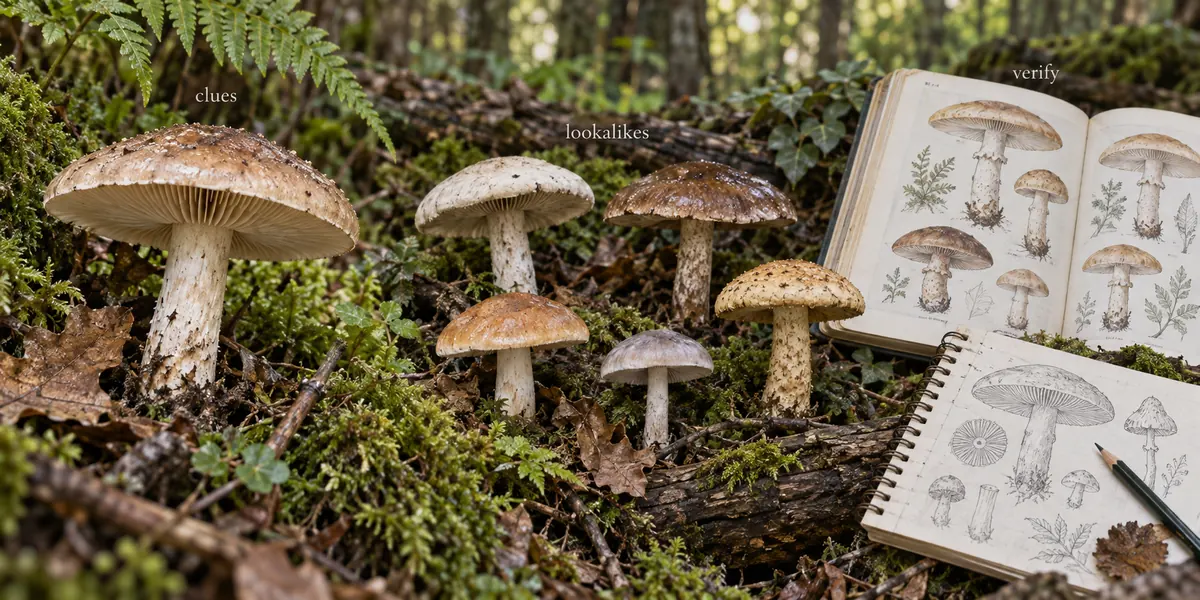
- Use the result to choose a better question, not to claim certainty.
- Check whether the explanation refers to features that are genuinely visible.
- Compare lookalikes with a regional guide or qualified local expert.
Improve the next upload
Avoid common mushroom photo mistakes
Most unhelpful photo searches fail because the image removes context or makes one clue look more important than it is. A close crop may show texture but hide the base; a wide landscape frame may show habitat but lose the underside; a filtered image may make a brown mushroom look orange or gray. Better identification starts with a small set of complementary views.
Keep the decision safe
A photo cannot prove edibility or toxicity
The phrase identify mushroom by photo can sound more certain than the evidence allows. A photo-based tool can organize visual clues, but it cannot prove that a mushroom is edible, non-toxic, safe for a pet, safe to touch, or suitable for a medical decision. Similar-looking species and local variation make confident guesses especially risky.
Do not eat an unknown mushroom because an app, search result, social post, or familiar-looking picture suggests a match. Do not taste it to test an identification, and do not use a photograph as a substitute for local poison-control guidance if someone may have been exposed.
- Visual similarity is not a safety certification.
- Never taste an unknown mushroom to test a guess.
- Keep children and pets away from unknown specimens.
Common questions
Mushroom photo identification FAQ
These answers explain what a photo workflow can do and where it must stop.
Can I identify a mushroom from one picture?
Sometimes one clear image can suggest a broad visual group, but one picture often hides the underside, stem, base, or habitat. Take complementary views and keep uncertainty visible.
What is the best photo for mushroom identification?
Use sharp, even light and show the cap, side profile, underside, stem, base when visible, and a wider frame of the growth surface. Avoid filters and deep shadows.
Can an app identify a mushroom by image?
An app can compare visible patterns and suggest a likely match, broad group, lookalikes, or next photo. It cannot confirm every species or make an edibility or toxicity decision.
Should I include the mushroom's location?
Yes. Region, season, substrate, nearby trees, weather, and growth pattern can improve research context. They support comparison but do not prove identity or safety.
Safety and reference context
Further reading
Use local, authoritative guidance for exposure questions and region-specific identification decisions.
- Poison ControlGeneral poison-exposure information and contact guidance for the United States.
- USDA Forest ServiceA starting point for public-land and regional forest information; local guidance still matters.