
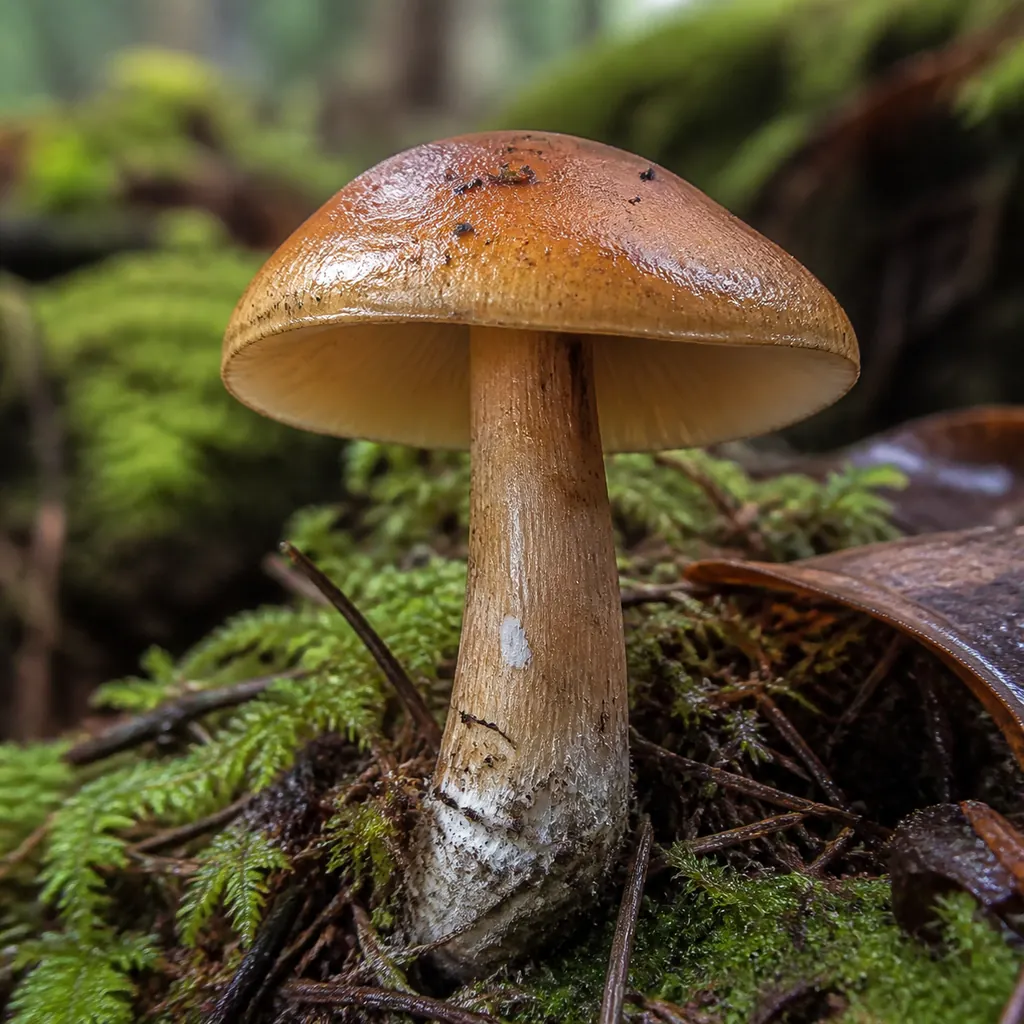
Short answer: Mushroom identification is strongest when several clues agree: cap shape and surface, gills or pores, stem and base details, how the mushroom grows, and where it was found. Start with a sharp photo and use any result as a research lead. If the question affects eating or medical safety, stop at visual comparison and ask a qualified local expert.
Start with the evidence
What a mushroom photo can show
A useful identification photo gives a reader or tool enough visual evidence to compare more than one obvious feature. Color alone is usually a weak shortcut because light, moisture, age, camera settings, and nearby surfaces can change how a mushroom appears. Shape, texture, underside structure, attachment, and habitat context are more useful when they are visible together.
Think of the first result as a narrowing step. It can help you describe the mushroom, find a relevant field-guide section, or decide which additional angle would resolve an uncertainty. It should not turn an ambiguous wild mushroom into a confident species name, and it should never be used as permission to eat or handle an unknown specimen.
- Cap: outline, surface, color variation, edge, bruising, scales, zones, and whether it changes with age.
- Underside: gills, pores, teeth, folds, spacing, attachment, and the color of the fertile surface.
- Stem and base: thickness, texture, ring, socket, volva-like structure, attachment, and visible discoloration.
- Context: soil or wood, clustered or solitary growth, season, nearby plants, moisture, and a rough size reference.
Compare several features
Read the cap, underside, stem, and habitat together
The most useful mushroom identification habit is to describe what is actually visible before searching for a name. Write down the cap profile, underside type, stem attachment, growth surface, and any changes after touching only when a trusted guide says that observation is appropriate. This keeps a memorable color or familiar-looking silhouette from dominating the comparison.
A visual identifier follows a similar logic at a broad level: it can compare patterns in an image and return a likely match or group, then surface lookalikes. A good guide or expert will still ask for local context, maturity, microscopic features, spore information, or additional tests that a single image cannot provide.
Cap shape and surface
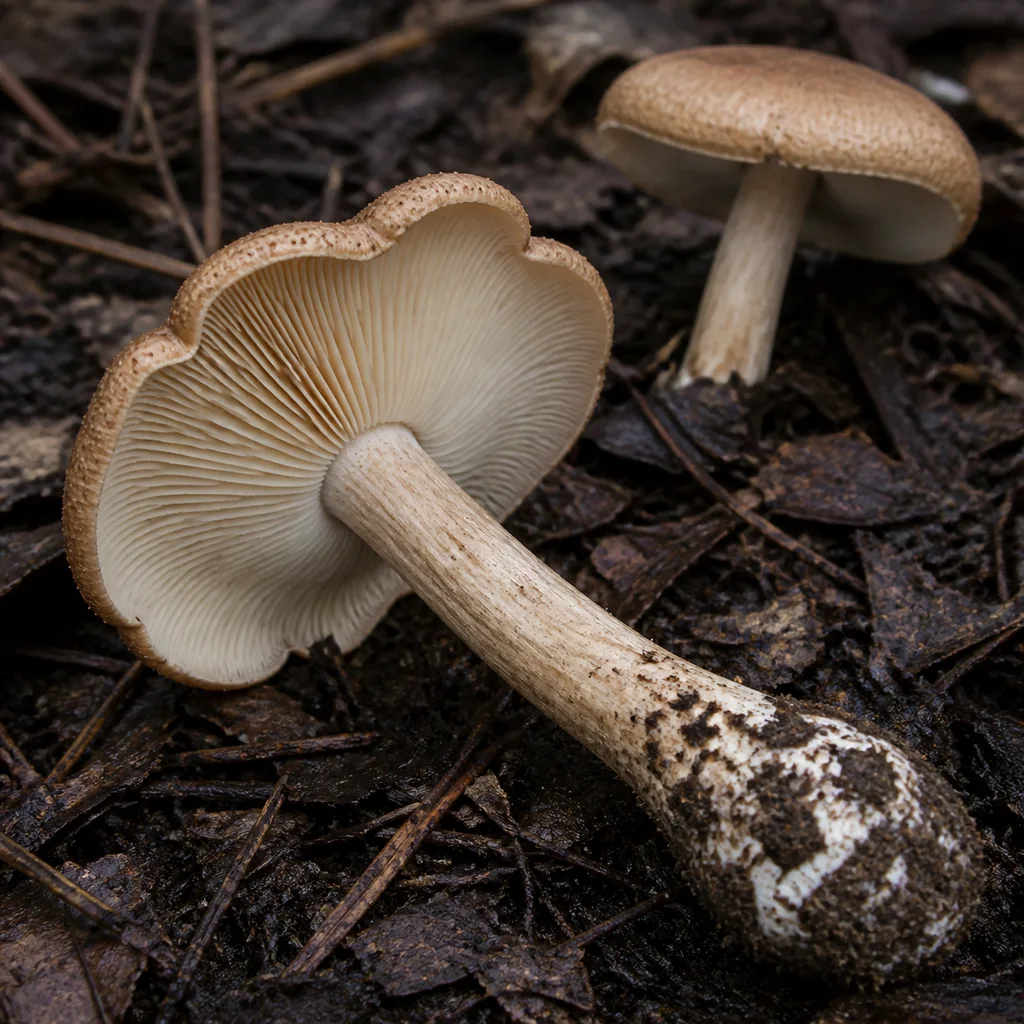
Describe whether the cap is convex, flat, depressed, funnel-shaped, bell-shaped, or irregular. Then note surface details such as scales, fibers, cracks, zones, stickiness, hairs, or a smooth finish. The margin can be rolled, straight, wavy, striate, or split, and those details may change as the mushroom matures.
Photograph the cap from above and from the side. A side view shows profile and thickness; an overhead view shows the outline, center, margin, and pattern. Keep the wording observational: say what you can see instead of naming a species from the appearance alone.
- Use natural light when possible and avoid strong color filters.
- Include a scale reference without placing objects against or touching the specimen.
- Record whether the surface is dry, wet, shiny, fibrous, scaly, or cracked.
Gills, pores, teeth, or folds
The underside often narrows the broad group more effectively than the cap color. Look for gills, pores, teeth, or folds; note whether they run down the stem, attach to it, stop before it, or appear free from it. Spacing, thickness, branching, and color changes can also matter.
Do not hide the underside with a single top-down photo. Take a close, evenly lit angle that keeps the full underside in focus. If the mushroom grows on wood or in a cluster, include the attachment point because growth position can be part of the comparison.
- Show the underside edge and the point where it meets the stem.
- Keep moisture droplets and glare from obscuring the surface pattern.
- Use the broad terms gills, pores, teeth, or folds until a reliable source supports more detail.
Stem, base, growth pattern, and habitat
Stem details can separate lookalikes that share a cap color. Record whether the stem is central or off-center, solid or hollow if that is already known from a safe source, smooth or textured, swollen or narrow, and whether a ring or other structure is visible. The base can be especially important, so include it in the frame when it is visible without disturbing the mushroom.
Habitat is supporting evidence, not a verdict. A mushroom on a fallen log is different context from one growing in soil or moss, but habitat alone does not make an identification safe. Note the substrate, nearby trees or plants, cluster size, weather, and date as field notes that help a later comparison.
- Photograph the entire growth pattern instead of cropping to one cap.
- Keep a safe distance from unknown specimens and do not taste, smell closely, or handle them to improve a photo.
- Treat season and location as context that guides research, never as proof of edibility.
| Visible clue | Useful question | What it cannot prove |
|---|---|---|
| Cap | What is the profile, surface, margin, and color variation? | A species or an edible result from color alone |
| Underside | Are there gills, pores, teeth, or folds, and how do they attach? | That a lookalike is harmless |
| Stem and base | Is there a ring, socket, texture, or attachment detail? | That a missing base detail is unimportant |
| Habitat | Is it on wood, soil, moss, or in a cluster? | A safe eating decision or universal range rule |
Improve the next frame
How to take a better mushroom identification photo
A blurry or incomplete image gives an identifier very little to compare. You do not need a studio setup: even light, a steady camera, a clean lens, and a few intentional angles usually improve the evidence. Take the photos before moving on, and preserve the surrounding context in at least one wider frame.
If the first result is broad or uncertain, do not respond by taking dozens of nearly identical close-ups. Use the missing clue in the explanation: add the underside, show the stem base, include the growth surface, or capture a side profile. This makes the next attempt more informative and keeps the workflow focused.
A practical four-angle sequence
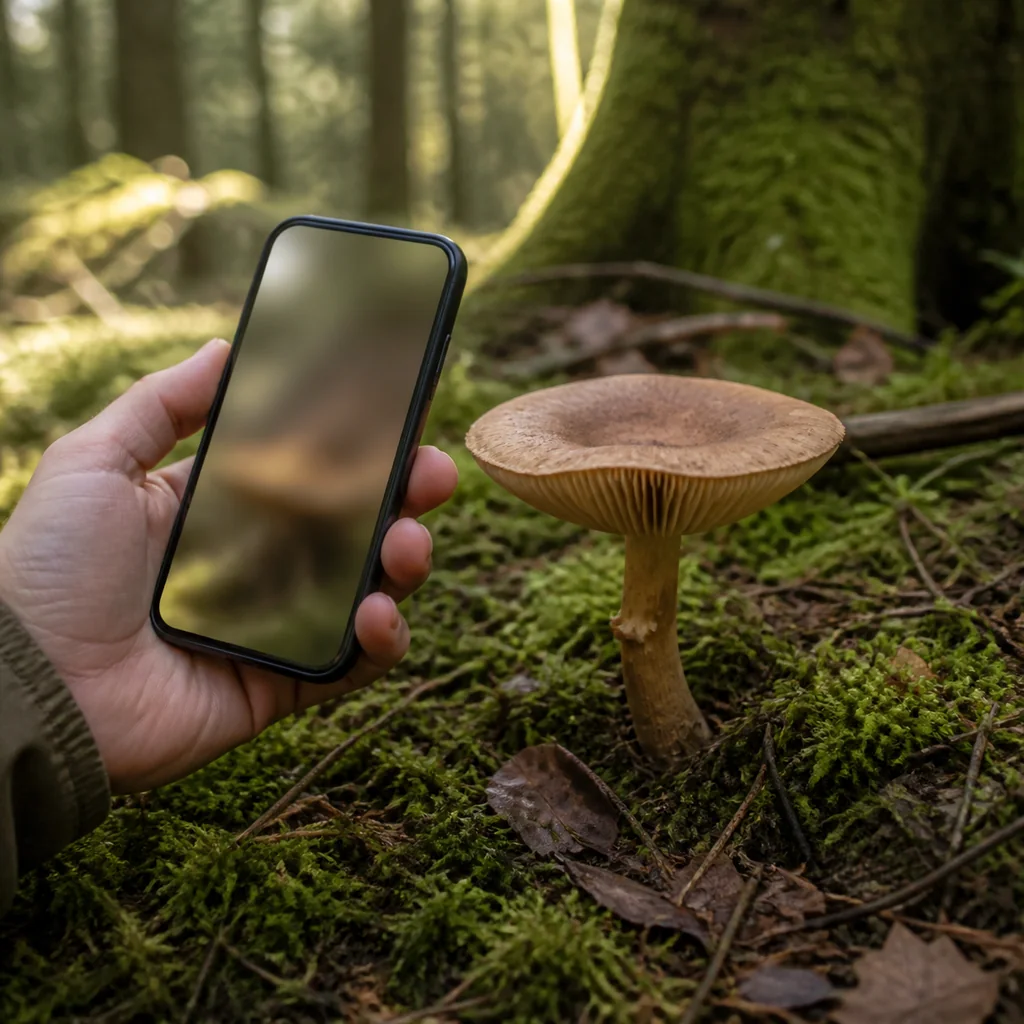
Start with a wider habitat photo, then take a cap view, a side profile, and an underside or stem-base view when those details are visible. Keep the camera parallel to the feature you are documenting and tap to focus before pressing the shutter. If the mushroom is in a group, include both the cluster and one individual close-up.
Use a simple note with the date, approximate location, substrate, nearby tree, and weather. These notes help you compare a result with a regional guide without pretending that a location alone identifies the mushroom.
- Wider context: show where the mushroom is growing.
- Cap view: show outline, surface, center, and margin.
- Side view: show profile, thickness, and stem proportions.
- Underside/base view: show gills, pores, attachment, and base context when possible.
Know the boundary
What mushroom identification photos cannot prove
A photograph records only a small part of a living specimen. It may miss smell, texture, bruising changes, spore print, microscopic structures, chemical reactions, maturity, regional variation, and the exact conditions where the mushroom grew. Even a sharp image can resemble multiple species or groups.
For that reason, Mushroom Identifier presents a likely visual match, broad group, visible clues, possible lookalikes, and a suggested next step. It does not provide a laboratory result, professional mycology certificate, toxicology assessment, or edible/poisonous verdict. The same boundary applies to any online photo tool or search result.
- Do not eat a wild mushroom because a photo, app, label, or search result looks confident.
- Do not use a photo guide as a substitute for a qualified local expert when safety matters.
- Keep children and pets away from unknown mushrooms and follow local poison-control guidance if exposure occurs.
- When the image is unclear, treat uncertainty as the correct result and gather safer context rather than forcing a name.
Avoid false confidence
Common mushroom identification mistakes
Many identification errors come from using one memorable clue as if it were a rule. A red cap, a ring on the stem, growth on wood, or a familiar common name can all be shared by unrelated mushrooms. Good identification keeps a short list of alternatives and asks what evidence would separate them.
The goal is not to win a guessing game. The goal is to make the next observation better, preserve the specimen and habitat safely, and know when a visual comparison has reached its limit.
| Mistake | Why it fails | Better habit |
|---|---|---|
| Matching by color | Lighting and age change color, and unrelated mushrooms can share it. | Describe shape, underside, stem, base, and context together. |
| Using one top-down photo | The underside and attachment are hidden. | Add a side and underside view without disturbing the specimen. |
| Assuming habitat proves identity | Many groups share soil, wood, moss, or the same season. | Use habitat as supporting context only. |
| Treating a confident result as a safety verdict | Visual similarity is not toxicology or expert verification. | Stop at a research lead and ask a qualified local source. |
Mushroom Identification FAQ
Questions people ask before identifying a mushroom
These answers explain what a photo-based guide or online identifier can do, where it stops, and how to make the next research step more useful.
What is the best way to start mushroom identification?
Start by recording the cap, underside, stem, base, growth surface, habitat, date, and approximate location. Take clear photos from above, from the side, and of the underside when possible. Use a field guide or online identifier to narrow the comparison, not to make an eating decision.
Can I identify mushrooms from a photo?
A photo can support a likely visual match or broad group when the important features are visible. It can also reveal which follow-up angle may help. A single image cannot reliably confirm every species, local variant, toxicology detail, or safety outcome.
What mushroom is this if it has a brown cap and pale gills?
That description is not specific enough by itself. Brown caps and pale gills occur across many unrelated mushrooms. Add cap texture, margin, stem and base details, attachment, growth surface, size, and habitat before comparing candidates.
Can mushroom identification tell me if a mushroom is edible?
No. Do not eat a wild mushroom based on a photo, app, search result, or a confident-sounding name. Edibility and poisoning risk require appropriate local expertise and safety guidance, and a photograph cannot replace that assessment.
Should I pick a mushroom to photograph the base?
Do not disturb an unknown mushroom just to improve a photo. Photograph the visible base and surrounding growth context when possible, and follow local conservation and expert guidance if a qualified person needs a specimen.
Why does an identifier show possible lookalikes?
Lookalikes are a useful uncertainty signal. Several mushrooms can share a cap color, shape, underside pattern, or habitat, so the result can show what else deserves comparison and what photo or expert observation could separate the possibilities.
Further reading
Use local, authoritative guidance when the stakes are higher
These external references support the visual-observation and safety boundaries in this guide. They do not turn a photo into a species or edibility certificate.
- MushroomExpert: Mushroom identification resourcesA specialist reference site for comparing mushroom features and terminology.
- Poison Control: Wild mushroom poisoning guidanceSafety information for suspected exposure; use local emergency and poison-control contacts.
- USDA Forest Service: Mushroom and ethnobotany resourcesA first-party reference point for additional field and natural-history context.