
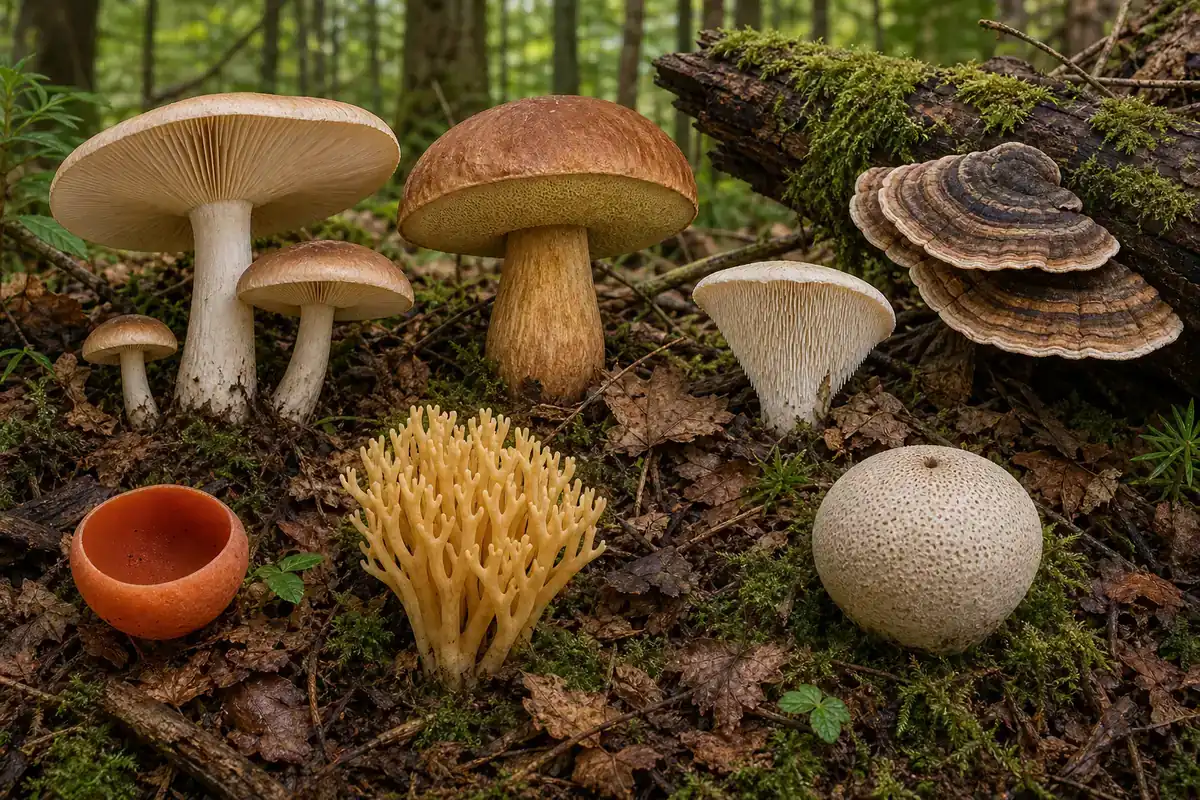
Short answer: A good mushroom identification chart with pictures is a comparison aid. Start with the broad shape, then check the cap surface, underside, stem attachment, base, growth surface, and habitat together. Unrelated mushrooms can share a color or silhouette, so keep several possibilities open.
Start with visible evidence
How to read a mushroom identification chart with pictures
A picture chart works best when each row answers practical questions. What is the growth form? What is visible under the cap? How does the stem meet the cap and ground? Is it on wood, in soil, or in a cluster? These observations are more useful than scrolling through names until one image feels familiar.
Use the chart from broad to specific. First sort the specimen into a group such as gilled, pored, toothed, folded, cup-shaped, club-like, puffball-like, or bracket-like. Then compare two or three independent features. If the photo hides the underside or base, mark that evidence as missing instead of assuming it matches the closest row.
- Describe what is visible before searching for a name.
- Compare cap, underside, stem or base, and growth surface.
- Keep habitat and season as supporting context.
- Use qualified local guidance when food or health is involved.
Begin at the top
Cap shape and surface clues in mushroom pictures
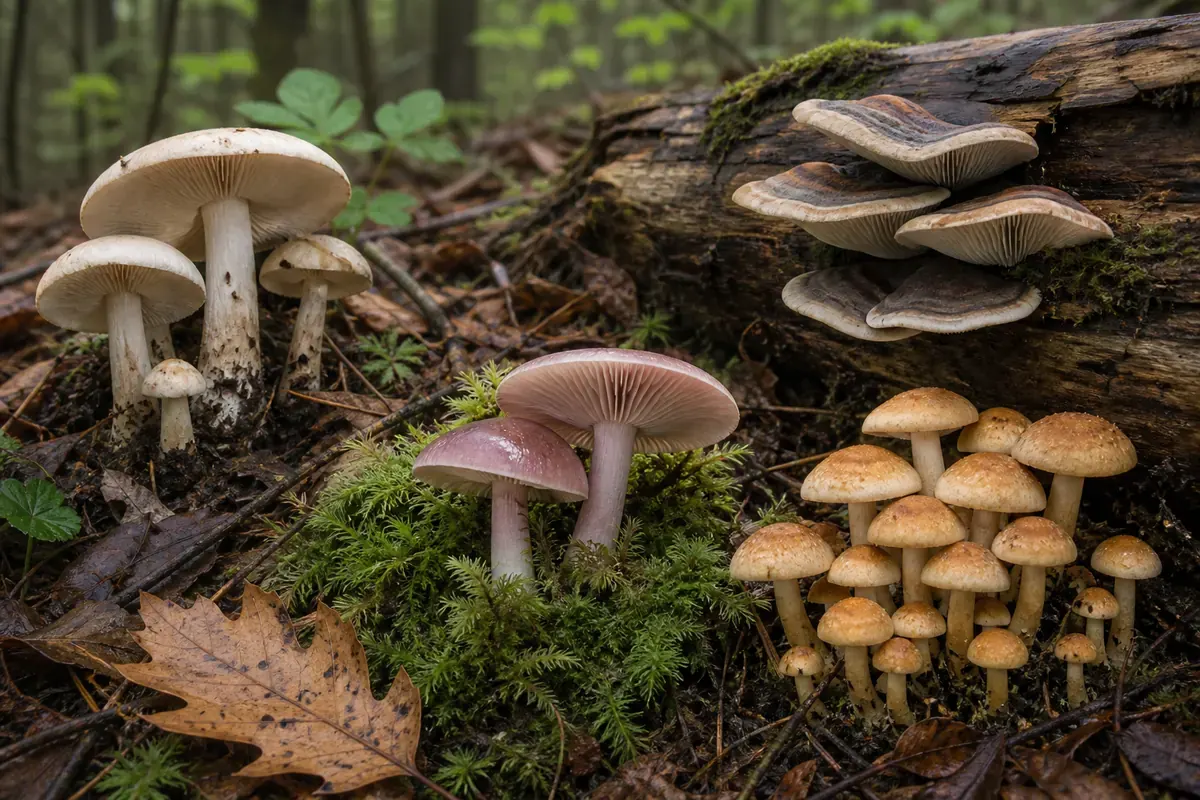
The cap is the feature most people notice, but it is rarely enough by itself. Record the profile from the side: convex, flat, depressed, funnel-shaped, bell-shaped, or irregular. Then note the margin and surface. Is the edge rolled, wavy, striate, cracked, scaly, fibrous, sticky, dry, or smooth? A cap can change as it expands, dries, bruises, or ages, so a picture should show the outline rather than a cropped color patch.
Take one photo from above and another at cap level. The overhead view shows the center, zones, scales, and margin; the side view shows thickness, profile, and the relationship between cap and stem. Avoid strong filters and colored lights, and write observations in neutral language.
Turn the mushroom over visually
Gills, pores, teeth, and folds are high-value chart clues
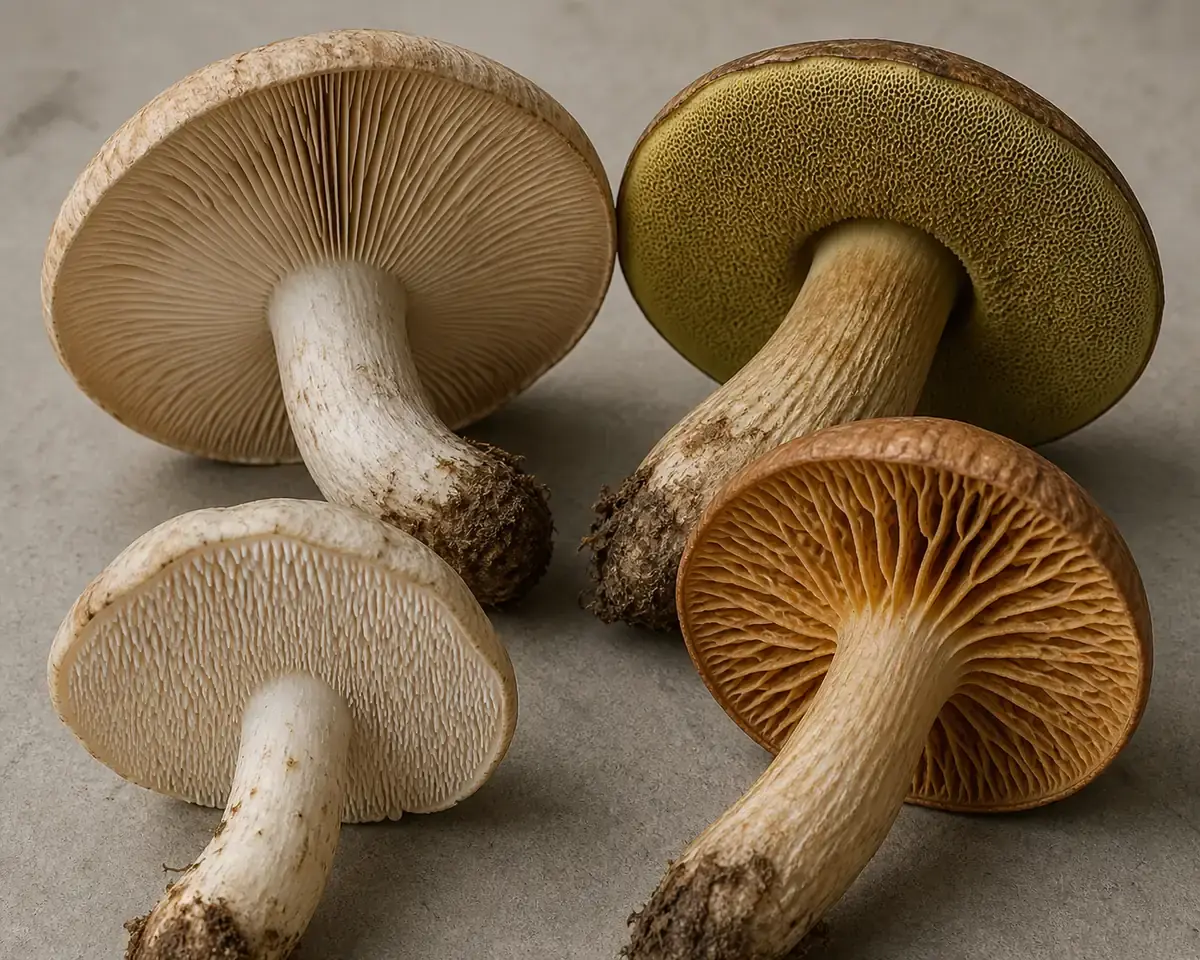
The underside often narrows a group more effectively than the cap. Gills look like radiating plates, pores like a sponge or field of openings, teeth like short hanging spines, and folds like thicker irregular ridges. The point where the structure meets the stem is also useful: it may appear attached, running down, stopping short, or free. These words describe visible relationships; they are not shortcuts to a species name.
A top-down picture hides this evidence. Use even light and focus on the full underside, including the cap edge and stem connection. If the mushroom grows on a log or in a tight cluster, include the attachment point. Keep the description broad when moisture, damage, maturity, or low resolution makes the structure uncertain.
Complete the picture
Stem, base, growth surface, and habitat context
Stem details often separate lookalikes that share a cap color. Record whether the stem is central or off-center, smooth or textured, even or swollen, and whether a ring or other visible structure is present. The base may be hidden by soil or leaves, yet it can be one of the most important parts of a comparison. Photograph what is already visible; do not dig up or break an unknown mushroom to improve the frame.
Growth surface adds context. Note soil, moss, leaf litter, buried wood, a living tree, or a fallen log, and whether the mushroom is solitary, scattered, or clustered. Add date, rough location, weather, nearby plants, and a size estimate. Many groups share the same substrate and season, so habitat supports a chart row but does not prove identity or safety.
| Feature | Useful observation | Missing evidence to flag |
|---|---|---|
| Stem | Central or off-center, smooth or textured, with visible ring details | The base is cropped or hidden |
| Base | Swelling, socket-like structure, fibers, or contact with soil | The specimen was not disturbed, so do not assume the base |
| Growth surface | Soil, moss, leaf litter, buried wood, or a log | Substrate is outside the frame |
| Pattern | Solitary, scattered, shelf-like, or clustered growth | Only one cap is shown |
| Context | Date, weather, nearby plants, region, and rough scale | Location or season is unknown |
Use the matrix
Mushroom identification chart: picture-led comparison table
The rows below are broad visual categories rather than a complete scientific taxonomy. Start with the row that matches the whole growth form, then compare the next column with your photos. If two rows remain plausible, keep both and photograph the separating feature. Record what is not visible as carefully as what is visible.
Use broad terms in your notes: gilled, pored, toothed, folded, cup-shaped, club-like, puffball-like, or bracket-like. A field guide or local expert can later add precise terminology. Mushroom Identifier can organize a likely visual group, visible clues, lookalikes, and a next-photo suggestion, but its result remains a research lead.
| Broad visual group | Picture clues | Best next frame | Do not infer |
|---|---|---|---|
| Gilled | Radiating plates below a cap | Full underside and stem attachment | A species or edible result |
| Pored | Many small openings with a sponge-like texture | Pores, cap edge, and substrate | That every wood-growing form is safe |
| Toothed | Hanging spines or short teeth | Side profile and underside | That a lookalike is harmless |
| Folded or ridged | Thick, blunt, irregular underside lines | Close underside in even light | A specific name from texture alone |
| Cup-shaped | Open bowl or cup with a visible rim | Interior, rim, and substrate | A final identification from silhouette |
| Club or coral-like | Upright or branching body | Whole growth pattern and base | That color makes the group certain |
| Puffball-like | Rounded body without an open cap and gills | Surface, base, size, and maturity context | Safe eating or internal condition |
| Bracket-like | Shelf or fan attached to wood | Attachment, layers, and underside | A universal rule for all wood fungi |
Keep uncertainty visible
Lookalikes, missing evidence, and chart limits
A good mushroom chart shows where resemblance stops being reliable. Several unrelated mushrooms may share a cap color, a ring, a shelf shape, or the same woodland habitat. A common name can also refer to a group, a cultivated product, or a regional usage rather than one confirmed species. When two rows look close, ask which feature would separate them and whether your photo actually contains that feature.
A picture cannot reveal every trait used in professional identification. It may miss smell, texture, bruising changes, spore information, microscopic structures, chemical reactions, maturity, and local variation. For food or health decisions, do not eat, taste, or handle an unknown specimen because it matches a chart or an AI result. Keep the photos and notes, then contact a qualified local source appropriate to your location.
- Use the chart to improve observation vocabulary and the next photo.
- Do not treat a confident caption, app label, or search image as a safety certificate.
- Keep children and pets away from unknown mushrooms and follow local guidance.
Mushroom chart FAQ
Questions about mushroom identification pictures
These answers explain how to use a picture chart without confusing a broad visual group with a confirmed species or a food decision.
What is a mushroom identification chart with pictures used for?
It helps you compare visible features such as cap profile, underside structure, stem attachment, base, growth surface, and habitat. Use it to narrow research and choose a better next photo, not to confirm a species or edibility.
Which mushroom features should I photograph first?
Start with a wider habitat frame, then capture the cap from above, a side profile, and the underside or visible base. Keep the full specimen and stem connection in focus.
Are gills, pores, and teeth enough to identify a mushroom?
They are valuable clues, but they are not enough by themselves. Compare the cap, stem, base, growth surface, maturity, and regional context, and keep lookalikes in view.
Can a mushroom chart tell me whether a mushroom is edible?
No. A chart, photograph, app, or search result cannot replace qualified local safety advice. Do not eat an unknown wild mushroom because it resembles a familiar row or name.
Why does the chart use broad groups instead of exact species?
Broad groups are more honest with one picture and make missing evidence clear. Exact identification may require local knowledge or expert review.
Further reading
Use local guidance when the stakes are higher
These references support the chart’s observation vocabulary and safety boundary.
- MushroomExpert: Mushroom identification resourcesA specialist reference for comparing mushroom structures and terminology.
- Poison Control: Wild mushroom poisoning guidanceSafety information for suspected exposure; use local emergency and poison-control contacts.
- USDA Forest Service: Mushroom resourcesA first-party field reference.